When natural resources like oil, natural gas, coal, and potash are extracted from federal and trust lands in Utah, the financial benefits extend far beyond energy markets. A longstanding statutory structure between federal, state, and local governments ensures that payments generated from extractive industries support public services, infrastructure, and education. Let’s discuss how those revenues are collected and distributed in the Utah state budget.
Background
Before 1920, public lands were governed by the General Mining Act of 1872, which allowed companies to retain claims and extract resources royalty free. In the early 20th century, Congress enacted the Mineral Leasing Act to 1) retain federal ownership of energy-rich public lands, 2) create a legal framework for leasing instead of selling permanent land claims, and 3) ensure taxpayers receive fair returns on nonrenewable resources.
The current version of the Mineral Leasing Act (MLA) distinguishes between “leasable” minerals and “locatable” minerals (such as gold and silver). Leasable minerals are subject to the MLA, while locatable minerals are subject to older laws. Leasable minerals include fossil fuels (such as oil, natural gas, coal) and industrial minerals (like potassium/potash, sodium, phosphate). The MLA specifies that 50 percent of royalties, land rentals and competitive bonus bids are returned to the state where the extraction occurred. Of the remaining royalties, 40 percent are deposited into the Department of Interior’s Reclamation Fund for water development projects, and 10 percent is retained by the U.S. treasury for general administration.
How Lease Funds Flow Through the Utah Budget
The Bureau of Land Management hosts competitive auctions for mineral leases on eligible federal lands. Operators pay three types of fees:
- bonus bids (upfront cash bids paid to secure a competitive lease),
- rentals (annual fees paid while holding a lease prior to active production), and
- royalties (a statutory percentage of the total value of minerals extracted and sold once production begins).
The Department of the Interior’s Office of Natural Resource Revenue collects these payments and makes monthly transfers to the Utah State Treasurer. The revenue is intended to offset a portion of the financial impact of reduced taxation for local governments due to federal land ownership. Federal law gives broad discretion over how states spend their allocations, specifying that funds should prioritize planning, construction, and maintenance of public facilities, along with the provision of public services in areas impacted by mineral extraction.
In response, Utah enacted UCA 59-21, “Mineral Lease Funds,” which separates fees paid by extractors into three buckets for specific uses:

- Mineral Lease Account. Standard revenues from ongoing royalties and land rentals are deposited into the Mineral Lease Account, which is referred to as Federal Mineral Lease in the state’s budget.
- Political subdivisions. The largest recipient of revenues across all categories of operator fees is political subdivisions that are impacted by resource extraction. These funds are administered by the Division of Finance ‘Mandated’, which is a program that handles transfers that impact several agencies, do not apply to any specific agency, or pose a conflict of interest to agency management. For FY 2027, the estimated transfer from Finance for impacted political subdivisions (across all three buckets in the chart above) is $27.7 million.
- Permanent Community Impact Fund. The other major transfer is to the Permanent Community Impact Fund (estimated at $25.5 million for FY 2027) within the Department of Workforce Services. The Fund is overseen by a board which awards loans and grants to communities impacted by extractive industries. Administratively, the Community Impact Fund deposits revenue from Bonus Payments into a separate fund, which only provides loans (estimated at $8.3 million for FY 2027). Because bonus bids are highly market driven, the Mineral Bonus Account is more volatile than typical federal mineral lease.
The FY 2027 estimated revenue for all sources across all recipients in the state budget is found in the table below, broken out by appropriations subcommittee. Note that Executive Appropriations, Social Services, and Transportation and Infrastructure appropriations subcommittees do not receive ongoing appropriations from these accounts.
| Subcommittee | Mineral Lease Account | Mineral Bonus Account |
| Economic and Community Development | $28,483,700 | $8,342,200 |
| General Government | $27,797,500 | |
| Higher Education | $1,745,800 | |
| Natural Resources, Agriculture, and Environmental Quality | $1,292,800 | $1,069,300 |
| Public Education | $1,848,700 | |
| Total | $61,168,500 | $9,411,500 |
The Land Exchange Distribution Account
Alongside standard federal mineral leases, Utah manages a closely related companion stream governed by UCA 53C-3, the Land Exchange Distribution Account. Occasionally, the School and Institutional Trust Lands Administration will exchange land assets with the federal government, typically because the state’s trust lands are landlocked within a federal parcel. In return, federal lands elsewhere in the state change ownership, excluding them from the mineral lease revenue calculations discussed in this post. To remedy this decrease in federal mineral lease and bonus revenue, the state has provided a similar mechanism through the Land Exchange Distribution Account (LEDA):
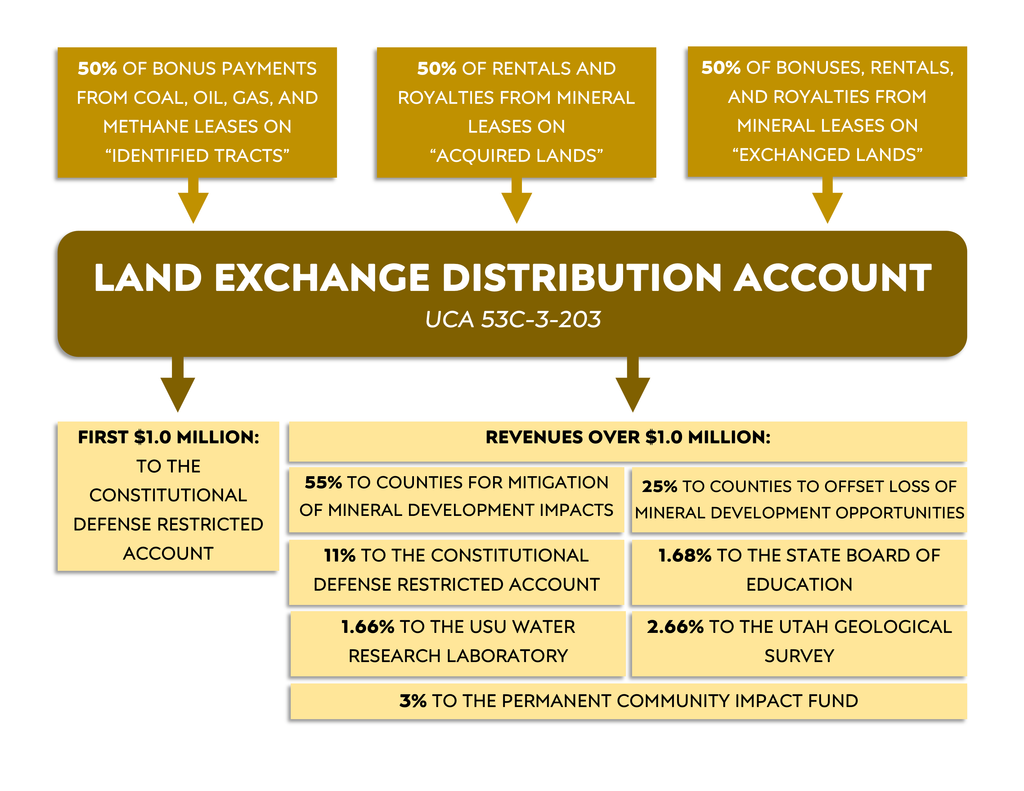
A primary difference in revenue distribution between LEDA and the Federal Mineral Lease/Bonus payments is the inclusion of the Constitutional Defense Restricted Account. This account is authorized to support a variety of state entities in federalism endeavors, including supporting the work of the Constitutional Defense Council and the Federalism Commission. Currently, funds from this account are only appropriated to the Public Lands Policy Coordinating Office to support operations ($1.5 million in FY2027).
Looking ahead, federal mineral lease revenues remain a non-trivial piece of Utah’s fiscal portfolio, bringing an estimated $70.5 million into state and local coffers for FY 2027. These distributions help balance municipal budgets by bridging the revenue gaps created by extensive tax-exempt federal land holdings across the state. Because extraction cycles are sensitive to global commodity markets and changing production schedules, forecasting these collections presents a persistent challenge. As Utah continues to strengthen its budgetary oversight, refining and modernizing revenue projection models will ensure state and local leaders can plan for the future with greater precision and confidence.