Each General Session, the Legislature discusses the “S.B. 102 money” and how to allocate it. You may recall, S.B. 102 “Higher Education Capital Facilities” (2019 General Session) created the Higher Education Capital Projects Fund, in which the Legislature prioritizes capital development projects for higher education and technical colleges using each institution’s dedicated funding in the case of degree-granting institutions, and utilizing a “winner takes it all” approach for technical college projects.
After six years of this approach, you may be asking yourself, “but is it working?” This is a simple question with a complex answer. Let’s discuss the ins and outs of higher education capital development funding and where the S.B. 102 money stands today.
What is S.B. 102?
The Higher Education Capital Projects Fund (HECPF), established during the 2019 General Session, provides ongoing funding to higher education institutions for capital development projects. While commonly referred to as one fund, two funds exist statutorily: the Higher Education Capital Projects Fund and the Technical Colleges Capital Projects Fund (TCCPF). The Higher Education Capital Projects Fund provides funding to Utah’s eight degree-granting institutions, and the Technical Colleges Capital Projects Fund (TCCPF) provides funding to our eight technical colleges.
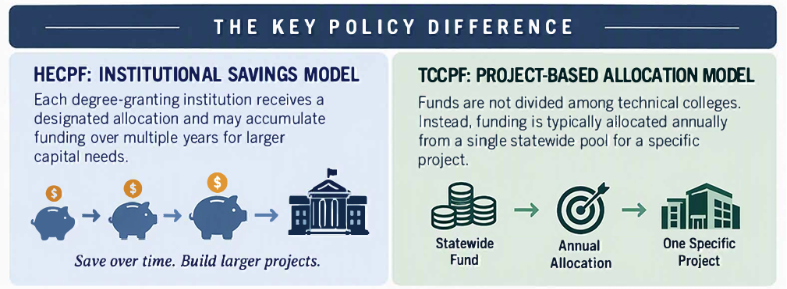
These two funds generally function the same way, with one exception: degree-granting institutions receive a specific allotment of the HECPF and can save up their allotment over multiple years for larger projects, whereas the TCCPF is not subdivided by institution and is typically swept annually for one specific project. Despite these differences, we will refer to these two funds collectively as HECPF throughout the rest of the post to reflect the historical approach of viewing the two funds as one unified policy decision.
In addition to establishing the HECPF, S.B. 102 provided guidance to the Board of Higher Education for when to bring a building request to the Legislature if that request exceeds an institution’s “piggy bank” balance in the HECPF or the total allocation to the TCCPF. The allocation was established to encourage institutions to focus on maximizing long-term planning and prioritizing lower-cost renovations and additions over higher-cost new builds. This approach is intended to save money and free up one-time funding to be used on other priorities.
Has S.B. 102 changed the state’s approach to higher education building?
To answer this question, any higher education building expenditures must be compared to baseline spending prior to the HECPF. To do so, we’ll compare the data for the five years before FY 2021 (FY 2016-2020) and the five years after FY 2021 (FY 2022-2026). (Due to the COVID-19 cuts, there was no capital spending in FY 2021 and the HECPF was fully implemented in FY 2022.)
When considering absolute dollars (not adjusted for inflation) as shown in Figure 2, the answer is no. Average spending in the baseline period was $121.0 million and average spending after the creation of the HECPF is $270.0 million, or a 122% increase. If you consider spending on buildings as a portion of the total state budget as shown in Figure 3, average spending in the baseline was 1.84% of the total state budget and 2.86% after the creation of the HECPF.
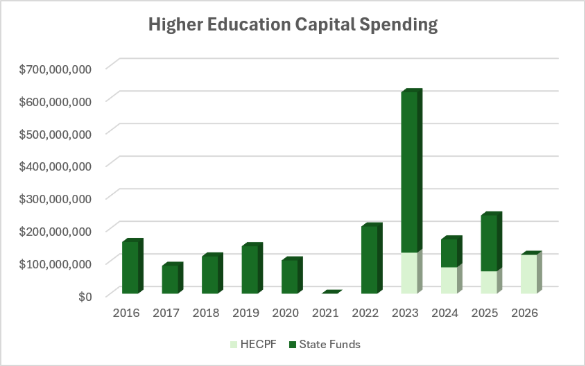
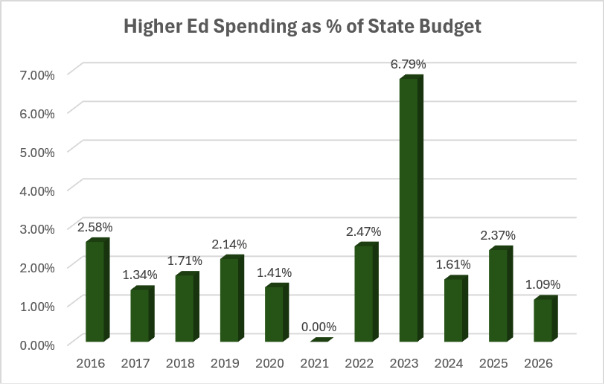
Looking at averages, however, does not convey the whole picture. A closer look shows that FY 2023 was an outlier year, with spending on higher education capital more than triple the next closest year. This shows that external constraints beyond the existence of the HECPF play a role in whether the Legislature funds a building each year.
A closer analysis looks at the average cost of a project before and after S.B. 102, as shown in Figure 4. This figure shows that the average cost per project increased by 15% over the course of a decade. When accounting for inflation over the same period (about 40%), we actually see that over time, institutions have shifted to proposing smaller-scale projects ( such as renovations or add-ons).
| Period | Spend | Count | Spend per Project |
| FY 16-20 | $606,191,200 | 26 | $23,315,046.15 |
| FY 22-26 | $1,351,239,500 | 50 | $27,024,790.00 |
Renovations vs. New Buildings
Figure 4 also highlights the increased number of projects brought to the Legislature after the creation of the HECPF. A closer look reveals that a higher education capital project can be sorted into three broad categories: new build, renovation (including additions) of an existing building, and a landbank or purchase of land (which may or may not include existing structures). Figure 5 shows the change in the type of capital project requested and eventually funded. This shows that renovation, as a portion of total projects, more than doubled from 15% to 34%, whereas new builds were reduced by 25%.

This suggests that while institutions are now completing more projects after the creation of the HECPF, they tend to be smaller in scale, with an emphasis on renovation rather than new buildings. As for the amount spent on buildings, that remains more a function of the State’s financial outlook and available one-time revenue than the existence of a dedicated capital projects fund.
2026 General Session & Beyond
Since the creation of the HECPF, Utah has continued to develop its process for funding these capital projects. During the 2026 General Session, the Legislature passed H.B. 508, “State Facilities Modifications” which requires the Higher Education Appropriations Subcommittee to hear and prioritize all capital development requests within the Utah System of Higher Education (UCA 53H-1-402(4)). Beginning in the 2027 General Session, a higher education institution requesting a capital project that goes beyond the scope of capital improvements will make that request to the Higher Education Appropriations Subcommittee in connection with the institution’s operating budget requests. This change brings all legislative funding requests for higher education under the purview of one appropriations subcommittee.