As the 2026 General Session gets cracking, so too does the Request for Appropriation (RFA) process. Before RFAs existed, many bills were drafted solely to appropriate money, even when no policy change was needed, which created a backlog for drafting attorneys. Today, RFAs function as their own structured pathway; one that improves efficiency, transparency, and the Legislature’s ability to prioritize funding during the fast‑paced 45‑day General Session. Even with a well established process, legislators must still accomplish a tricky task: prioritizing funding before revenues have hatched.
The following post summarizes the latest updates to the system along with a more comprehensive overview of the process and timing for budget requests.
The New Pecking Order
To improve transparency, the Legislature has implemented a numbering system for RFAs. Starting this year, you will see specific prefixes that identify the originating chamber of each proposal and a number indicating the order in which the request was submitted:
- H.A.R. (House Appropriation Request) ###: Sponsored by a member of the House of Representatives.
- S.A.R. (Senate Appropriation Request) ###: Sponsored by a member of the Senate.
This convention is familiar, as it’s very similar to the format used for bills. This update allows both staff and the public to better track requests, as identifiers can be used to distinguish topical requests. Instead of asking where the “water request” is at in the process, interested parties can use the specific RFA number. Requests automatically generated from fiscal notes will also be labeled (COBI example), and requests that are duplicative also will be identified as such (COBI example).
Requests can also be found in one place on the legislative website under “Legislator Requests for Appropriation”. Here you can see that some legislators choose to cast a wide net with many requests, while others prefer to put all their eggs in one basket.
You Can’t Make an Omelet Without Breaking A Few Eggs
The graphic below describes the life cycle of an RFA in the state budget:
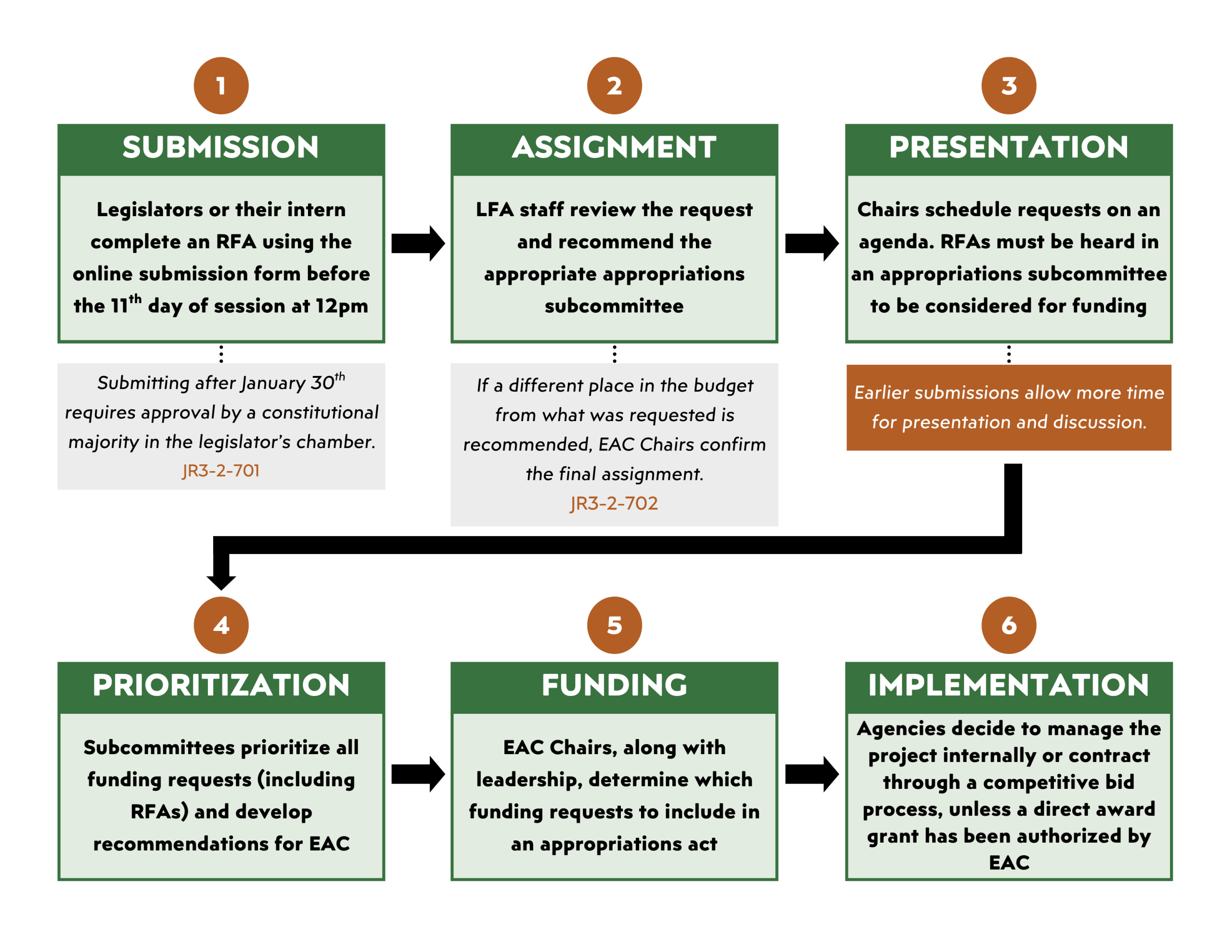
Every RFA must be presented in a public meeting to be eligible for inclusion in the final budget. Subcommittees review RFAs alongside existing base budgets and also items from the governor’s budget. When revenues are limited, reductions options identified by subcommittees help create capacity for higher‑priority requests. This balancing act allows legislators to weigh ongoing needs against emerging opportunities, ensuring that any additions to the budget are supported by sustainable funding.
The Early Bird Gets the Worm
By legislative rule, the deadline to file an RFA is 12 p.m. on the 11th day (or second Friday) of the General Session. This firm cutoff often leads to a last-minute scramble which can limit a proposal’s visibility. Take for example data from the last few General Sessions:
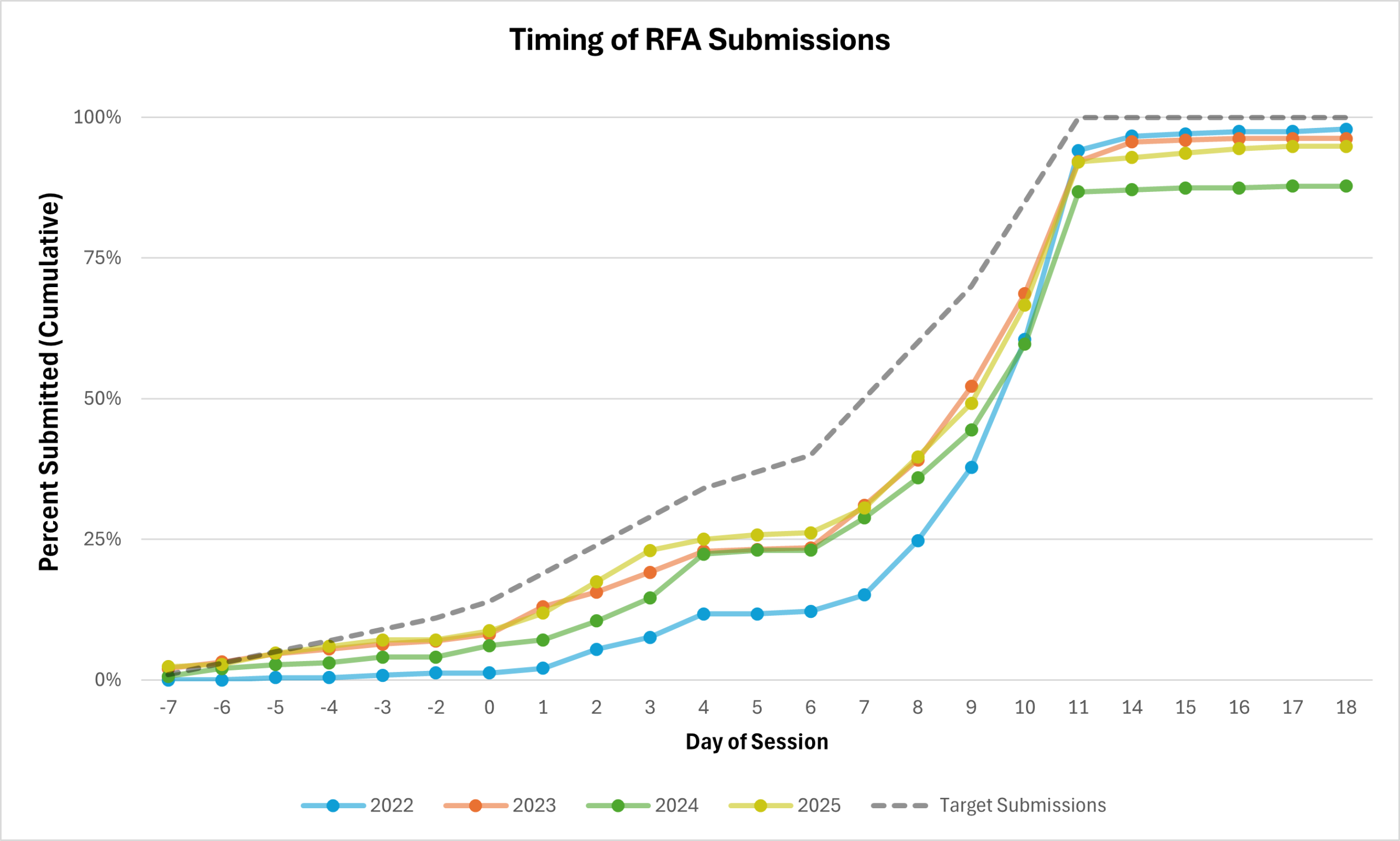
The area between the blue and yellow lines in graph above shows the improvement in timing made in the last four years. Since 2022, legislators and their interns have reduced the percentage of all requests submitted at the deadline, submitting requests about two days earlier on average. Ideally, a higher percentage of RFAs would be submitted prior to session and during the first week, providing subcommittees with the opportunity to schedule presentations more evenly during each of their scheduled meetings.
The benefit of submitting and presenting early is providing committees and the public with more time to consider requests improving transparency in the budgeting process. After the 11th day deadline, committees only have 2 to 3 meetings with which to fit dozens of requests. While it’s possible to hear more than 30 requests in a single meeting, legislators, staff, and the public end up with only minutes to understand how a sponsor is proposing to spend (in some cases) millions of state dollars.
Counting Chickens Before They Hatch
While this process is designed to provide transparency, it also highlights a recurring challenge: not all proposals can be funded. New appropriations depend on available revenues, with demand far exceeding state resources. In the last four years, RFAs alone averaged nearly three times the amount of all available funding.
The deadline for new funding requests occurs about four weeks before the February Consensus Revenue Estimates are released, creating a structural chicken and egg problem: policymakers must prioritize and rank their RFAs in early February, however the final nest egg won’t be known until later in the month.
As of the time of publication, 36 requests have been submitted with a total ask of $98.0 million one-time and $25.7 million ongoing.
Even with this timing challenge, the RFA process gives policymakers an early look at the full range of funding needs before final revenue figures are available. This process helps legislators ensure a balanced budget before it’s time to fly the coop.