Today is Friday the 13th, which most people might associate with bad luck, spooky occurrences, or maybe even a movie marathon featuring a 1980s cult classic (and its eleven sequels to date). In keeping with that theme, we’re covering something truly scary—the possibility that Utah’s resources might be spent on activities that don’t achieve the intended outcome.
Without a way to measure success, spending without insight could feel like a masked antagonist: a funding item that keeps coming back for more and never dies. The Legislature tackles this perpetual challenge by engaging in a regular cycle of performance measurement and evaluation of state spending to ensure no dollar is left in the dark. This post covers performance measure types along with an overview of the performance measurement cycle for both ongoing and new funding.
What is a performance measure?
Before we explain the cycle in more detail, it’s worth reviewing the basics. A performance measure is a metric that helps policymakers, agencies, and the public understand how well funding is being used. The graphic below describes the basic performance measure anatomy:

These measures come in many forms, all of which serve different purposes. (Mobile users may view this table better as a PDF in a new window.)
| Measure Type | Description | Examples | Application |
| Outcome Measures | These measures describe the positive changes in Utah’s society, environment, economy, or other areas that the state hopes to see because of state spending. While outcome measures can’t always demonstrate direct causation between state spending and changes in outcomes, they are still some of the most valuable indicators that state agencies are succeeding in their missions and that thoughtful spending is taking us in the right direction. | Public health outcomes like smoking rates and prevalence of mental health conditions. Economic outcomes like employment rates and housing affordability. Societal outcomes like graduation rates and recidivism | These measures can be extremely valuable to high-level decisionmakers, including legislators and administrators, as they determine whether state agencies are making progress toward their overall strategic goals and delivering outcomes that are responsive to their constituents’ needs. These measures are especially important when assessing mature programs or programs that make up a significant portion of state funding. |
| Process Measures | These measures describe how well work is being done, in terms of speed, cost, efficiency, or quality. When paired with outcome measures that tell us that spending is having an effect in a positive direction, these measures can tell us how effectively the state is using available resources to make those outcomes a reality. | Time to deliver a service or complete a task, the cost per unit of work, or the frequency of rework (as an indicator of quality). | These measures are often most valuable for those in managerial roles; process measures can either show where an agency’s operations are working efficiently and using resources well, or pinpoint where there might be bottlenecks that limit potential impact. These measures can also be very useful in state operations that are more public-facing or customer-oriented; improvements in timeliness and efficiency can be very salient to Utahns’ experiences and perceptions as they interact with state government services. |
| Input and Output Measures | These measures describe what resources have gone into a system and how much work has been completed using those resources. While these measures aren’t as meaningful as outcome or process measures, they can still give useful context as to the scale of an operation, are generally easier to measure, and provide the foundation for calculating many important process measures. | Funding received, staff hired, acres treated, events held, or the number of tasks completed. | While these measures are not as helpful as process or outcomes measures in evaluating the overall success of a program or spending, they can still provide some insights into the capacity and activity of a program; for instance, they can help identify whether backlogs may start to form over time if demand for a service is outstripping a program’s current output. These can also be used in new programs that have not had enough time to collect long-term outcomes data. |
A Sequel Worth Watching
For both the base budget and new funding requests, performance measurement follows the same fundamental cycle: Approve, Track, Report, Inform. Specific metrics, referred to in our budget process as performance measures, are assigned at the line item or funding item level and follow that state spending through the funding lifecycle.
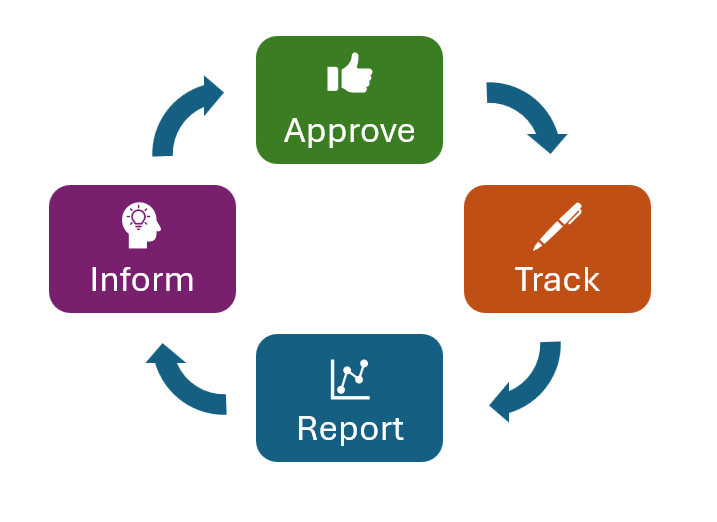
This creates a feedback loop that gives policymakers insight into which spending decisions have had the greatest positive impact (or which are proving ineffective). They can then integrate that information into future budgeting decisions, whether that be to increase funding for effective spending, recommend improvements to make spending more impactful or efficient, or reallocate funds from ineffective efforts to more promising items.
Measuring Ongoing Spending
When performance measurement was first introduced into the budget cycle, the Legislature required that at least three performance measures be associated with each line item in the state’s budget. Now, metrics are assigned based on clarity of outcomes and size of state investment. As such, the performance cycle for line-item measures consists largely of tracking trends for the same measures over time, but these ongoing metrics are reviewed annually and can be added, changed, or removed as needed.
- Approve: Each fall during interim meetings, the Legislature can authorize changes to existing line-item measures, as well as the addition or removal of line-item measures. These decisions are informed by LFA’s staff recommendations, which are developed with input and collaboration from executive branch agencies and the Governor’s Office of Planning and Budget. Once approved by EAC, each line item’s performance measures are included as intent language in the base budget bills.
- Track: As agencies implement programs and spend their state appropriations for each line item, they also track data on associated performance measures for the entire state fiscal year, beginning July 1 and ending June 30.
- Report: After the end of the fiscal year, agencies have 45 days to compile data and report results back to the Legislature. This data is delivered back to the Legislature through a centralized platform called “Performance Prep”, where the end-of-year actuals and additional contextual information is compiled for analysis and reporting.
- Inform: Before Fall interim meetings, the collected performance measure results are published on the Legislature’s Compendium of Budget Information (COBI) webpage and reported back to legislative appropriation subcommittees and EAC. This information, which provides both a snapshot of current performance and a view of trends over time, is integrated into budgeting discussions and decisions. Once again, measures are adjusted as needed and the cycle begins again for the new year.
Measuring New Spending
During the General Session, the Legislature considers hundreds of requests for new funding, including recommendations from the Governor’s Office and requests for appropriation (RFAs) made by individual legislators. Any items that receive funding are also included in the annual performance reporting cycle to ensure transparency and accountability for new spending.
- Approve: After items are funded at the end of the session and before the beginning of the fiscal year, each new funding item is assigned its own performance measure.
- Track: Just like line-item measures, as agencies implement new these new funding items, they also track data on the associated performance measure for the entire state fiscal year, beginning July 1 and ending June 30.
- Report: After the end of the fiscal year, agencies have 45 days to compile data and report results back to the Legislature. This data is delivered back to the Legislature through a centralized platform called “Performance Prep”, where the end-of-year actuals and additional contextual information is compiled for analysis and reporting.
- Inform: Before Fall interim meetings, the collected funding item measure results are published on the Funding Item Follow-Up Report webpage. These results inform LFA’s recommendations to the Legislature, including summaries of which items have been successfully implemented and achieved their targets, recommendations to follow up for additional years of reporting if needed, or recommendations to reduce or reallocate funding from items that have not proven successful.
Just as the performance cycle seeks to continuously improve Utah’s use of valuable state resources, the Legislative Fiscal Analyst is also refining the way that performance information is created, collected, and integrated into the budget process. Keep an eye out for new developments such as an enhanced focus on performance measures in this year’s Accountable Budget Process and clearer connections between agencies’ performance measures and their strategic plans, because when it comes to the state budget, the only thing policymakers should be afraid of is spending without accountability.